
What a litter actually costs: an honest per-litter P&L
Most breeders know the sale price and guess at everything else. The costs are knowable — and a litter that lost money should be allowed to say so.

Ask a breeder what a puppy sells for and you get an exact number. Ask what the litter cost and you get a pause, then a range, then a story about a c-section in 2022.
That is not carelessness. It is that the costs arrive over nine months, in a dozen small payments, from different places and nobody is keeping a running total while a whelping box is in the living room. But the number is knowable and knowing it changes decisions — which stud, which dam, whether to repeat a pairing at all.
The costs that actually go in
Working roughly in order of when they happen:
Before the mating. Health screening for the dam under whatever schemes the breed uses. Progesterone testing. Any pre-breeding veterinary work.
The mating itself. Stud fee, or the cost of artificial insemination and the collection and shipping around it. Travel — which people consistently forget and which for an overseas stud is not a rounding error.
The pregnancy. Ultrasound or radiography to confirm and to count. Additional feed for the dam, which rises sharply in the last third. Any supplements your vet recommends.
The whelping. Supplies — box, heat, bedding, replacement feeding kit, scales. And the one that determines whether a litter was profitable more often than any other line: the possibility of an emergency caesarean, out of hours.
The eight weeks after. Puppy food. Worming, repeatedly. First vaccinations. Microchips. Veterinary health checks. Registration fees. Replacing whatever the puppies destroyed.
Placing them. Advertising. Transport. Collars, blankets, the folder of paperwork each puppy leaves with. Time on the phone, which is a real cost even if it never appears in a ledger.
And afterwards. Returned deposits, refunds and the occasional puppy that comes back.
Revenue is not price times puppies
The second half is where honest accounting gets uncomfortable.
Deposits that never convert. Some become sales. Some are refunded. Some are forfeited. They are not revenue until they are.
Retained puppies. A puppy you keep generates no revenue. It is not a loss either — but it is not income and counting it at its notional sale price turns a loss-making litter into a profitable one on paper.
Gifted and placed-at-cost puppies. The right treatment is to count them at zero revenue rather than leave them out of the litter entirely. Omitting them makes the average look better; counting them at zero tells you what actually happened.
Currency. If you take a deposit in one currency and the balance in another, do not add them together. Keep each currency separate or the total is a fiction.
Per litter, not per year
An annual total tells you whether the year worked. A per-litter number tells you *which* litters worked, which is the number that changes what you do next.
Two litters can differ by a factor of three on cost alone — one straightforward whelping against one that needed a section and a week of supplementary feeding — and an annual average hides both.
What the app computes
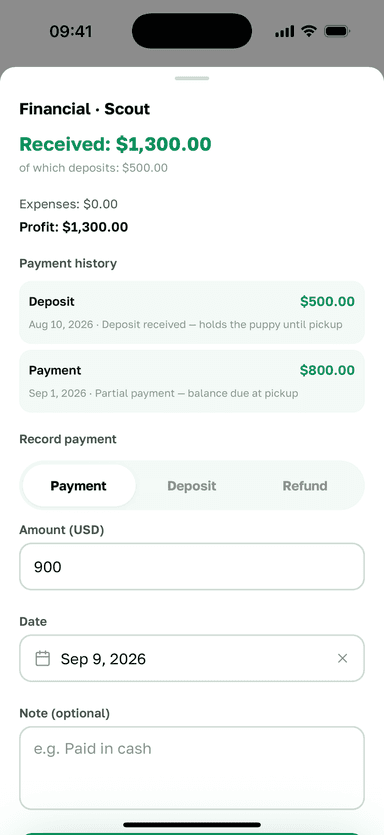
In EverPet's breeder mode, expenses are logged against the litter they belong to. Revenue comes from the payments recorded per puppy: each deposit and payment is an itemized, append-only entry with a live remaining balance, so at any moment there is an accurate figure for what has actually been collected rather than what was agreed.
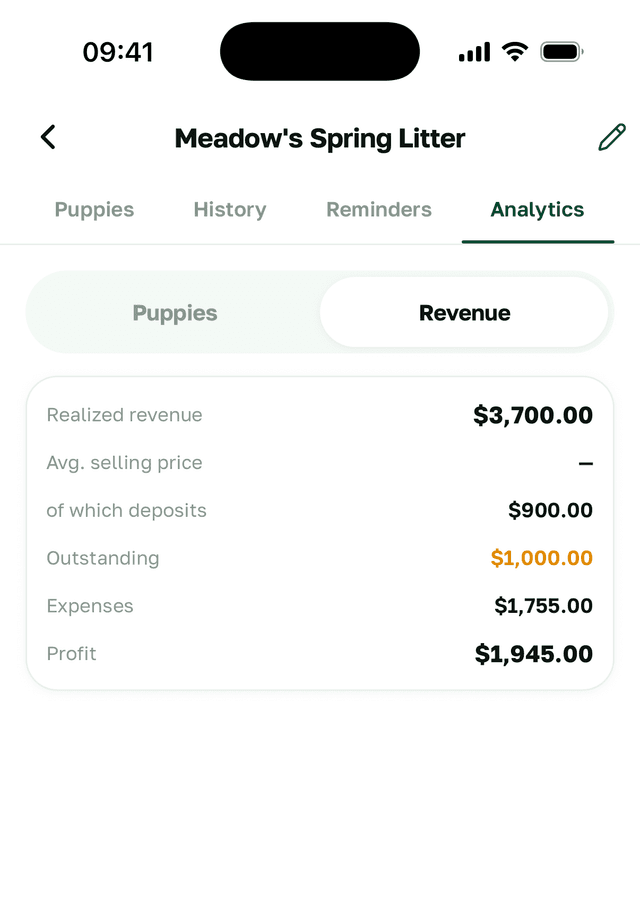
Those two sides roll up into a per-litter profit and loss view. It is per currency, never mixed. The profit figure is signed and never clamped — a litter that lost money shows a loss, in red, rather than a zero. Gifted puppies are counted at zero revenue rather than dropped from the litter. It is cash-basis and it does not flatter anything.
That view sits alongside the rest of the kennel toolset — litters, the four-stage sale pipeline from available through to transferred, buyers and their purchase history — which is laid out on the breeder page.
What it is not
Stated plainly, because the gap matters if you are deciding what this replaces:
- It is not tax-ready bookkeeping. It is not an accounting package and it is not receipt-backed
- Every expense entry is manual. There is no recurring or templated entry, no duplication
- It does not price your puppies. It tells you what the last litter cost. What you do with that
The number is worth having anyway
Most breeders discover, on the first honest pass, one of two things: that a litter they thought broke even did rather better, or that the one they remember fondly was carried entirely by not counting the section.
Either way it is a better position than the pause and the range. You cannot price work you have not measured.
Related
Get EverPet
Free to start, on iOS and Android.