
What paperwork should come with a puppy
A puppy arrives with a stack of documents and a lot of conversation. Here is what should be in the stack and what to do with it in the first week.

The day you collect a puppy is not the day to audit paperwork. There is a crate, a car journey, a family and an eight-week-old animal who has never been anywhere. The documents get put on the kitchen counter and stay there.
So here is the list to check *before* you go and the short version of what to do with the stack in the first week.
What should be in the stack
Identification. The microchip number and the paperwork confirming it — implantation record and registration details. This is the document that proves the puppy is the puppy.
A vaccination record. Dates, the product used and the vet or practice that administered each one. A card with dates and no product names is weaker than it looks: the next vet needs to know what was given, not only when.
A parasite treatment record. Worming is usually done several times before a puppy leaves; the dates and products belong on paper.
Health screening results for the parents, where the breed has recognised screening schemes. These belong to the dam and sire, not the puppy and a breeder who does them will usually offer them without being asked.
A veterinary health check for the puppy itself, if one was done before sale.
Registration or pedigree paperwork, if the puppy is registered — including whatever transfer form moves the registration into your name.
A contract or receipt, stating what was paid, what was agreed about returns or health guarantees and any conditions attached to the sale.
Practical notes that are not documents but should be written down anyway: what food, how much, how many meals a day, what the puppy has been socialised with and when the next vaccination is due.
The one people forget
Microchip registration. The chip is implanted and the number exists, but the database record still points at the breeder — or at nobody, if the implantation was never registered.
A chip that is not registered to you is a chip that reunites a found dog with somebody else's phone number. Transferring it is a short form with the registry named on the paperwork, it usually costs little or nothing and it is the single highest-value fifteen minutes of the first week.
Day one, in three moves
1. Book the vet. A first appointment in the first week, with the vaccination record in hand, so the practice can pick up the schedule where the breeder left it rather than starting again. 2. Transfer the microchip registration. As above. 3. Photograph everything. Every page, before anything gets folded into a drawer. Vaccination card, contract, registration paperwork, microchip confirmation, health results.
That third step is thirty seconds a page and it is what makes the next two years easy. A vaccination card photographed on day one still exists after a house move.
If the breeder uses EverPet
Some of this arrives digitally rather than on paper. A breeder using EverPet can send a structured transfer pack rather than a folder: the pet's own record, a snapshot of the litter with dam and sire details and whichever documents they chose to include.
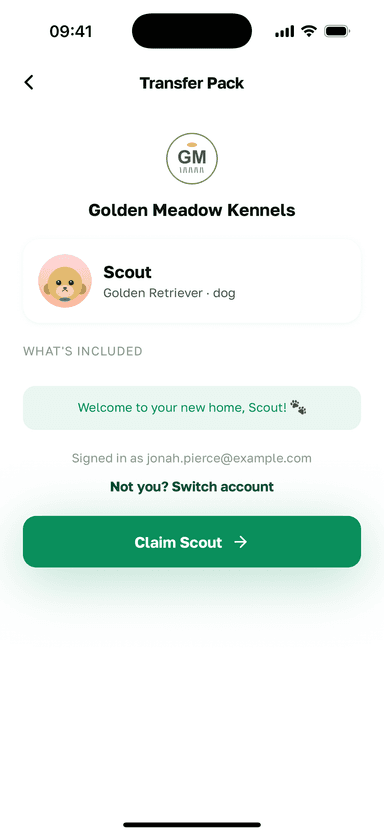
The mechanic worth understanding as a buyer is that nothing lands in your account on its own. You need to be signed into the app and you actively claim the pack — you see what is in it and you accept it. Nothing transfers without that action. Once claimed, the puppy's timeline and documents are yours, in your account, from before the day you collected her.
On the breeder's side there is a readiness check per puppy before a pack is sent — microchip, vaccines, documents, weight, date of birth — which is a decent proxy for whether a handover was done carefully. The rest of that toolset, from the litter through to the handover, is on the breeder page.
If they do not
Then you do it yourself with a phone camera, which is what most people are doing anyway. Photograph each document, file it against the puppy and the document type and you have the same record for the cost of ten minutes at the kitchen table.
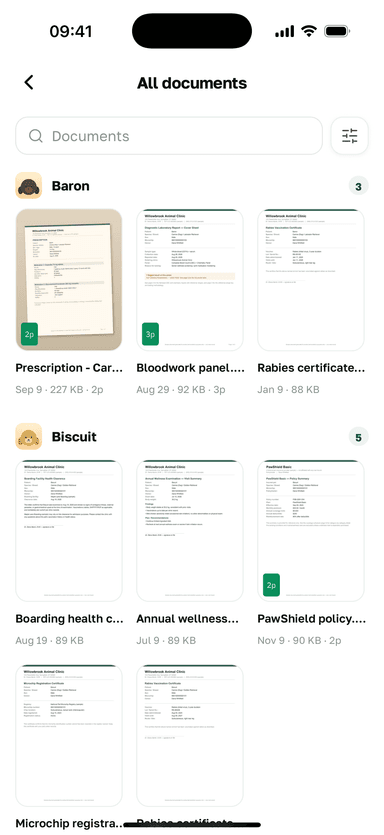
The advantage of doing it immediately rather than later is not tidiness. It is that the first six months of a puppy's life generate more paperwork than the next six years and none of it feels important until a vet asks what she was given in week ten.
Questions worth asking before you collect
- Has the microchip been registered and to whom?
- What has she been vaccinated with and when is the next one due?
- What has she been eating, how much and how many times a day?
- Was a health check done and can I see it?
- What happens if there is a problem in the first weeks — what does the contract say?
A breeder who has done this well will have the answers ready, often in a folder with your name on it. That folder is the thing to photograph.
Пов'язане
Встановіть EverPet
Безкоштовно для початку, на iOS та Android.