
Your dog's bloodwork, in plain words
How a veterinary lab report is laid out, what a reference interval actually is and the questions worth taking back to your vet.
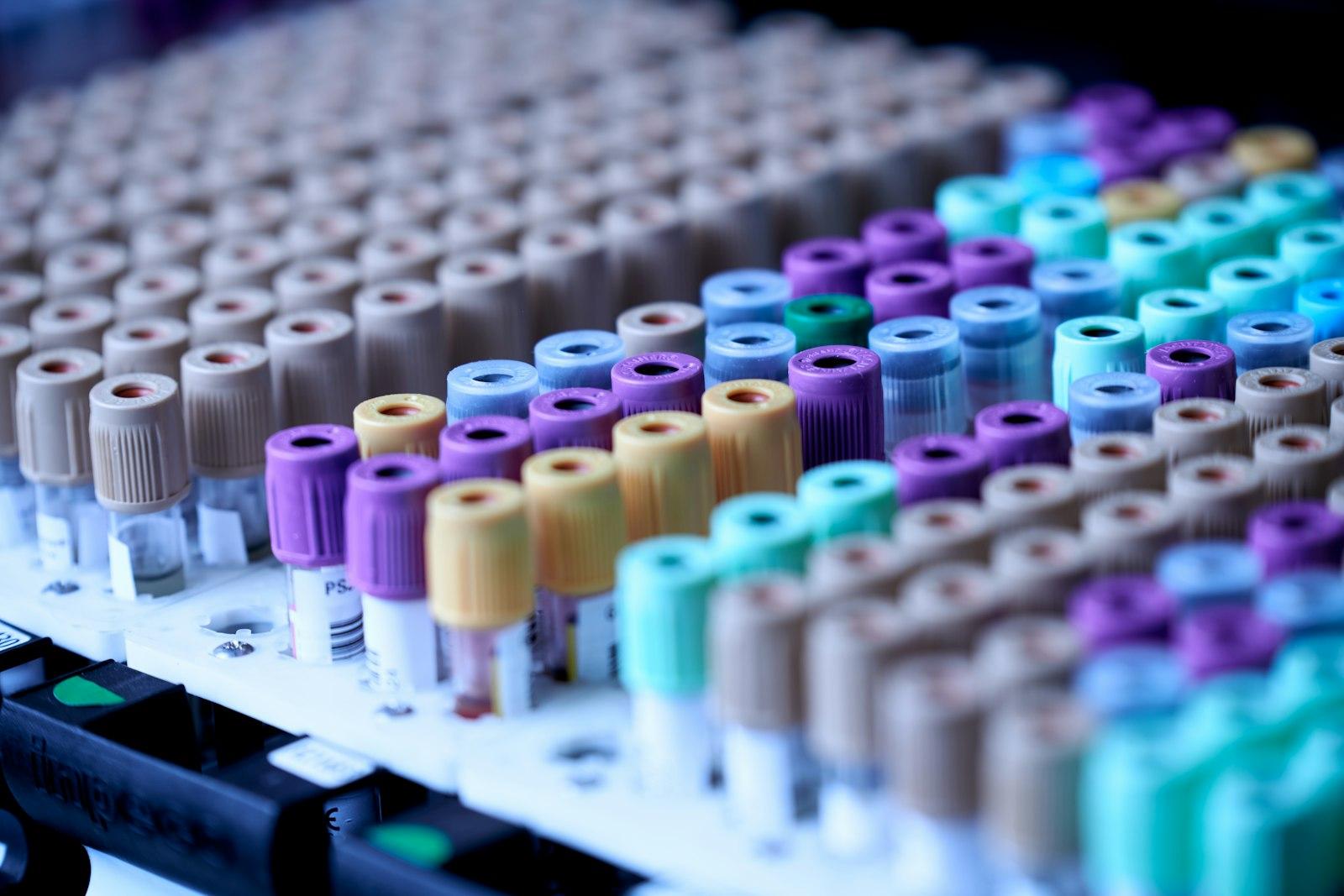
You leave the clinic with two sheets of paper covered in three-letter abbreviations, numbers and a column of ranges. Somewhere on it there is an H or an L next to something and it is going to be on your mind all evening.
This post is about reading the layout of that page — what the columns are, what the notation means, what a reference interval is and is not. It deliberately does not tell you what any result means for your animal. That is interpretation, it depends on the dog in front of the vet and it is the one part of this that genuinely requires a veterinarian.
How the page is laid out
Nearly every veterinary lab report has the same skeleton:
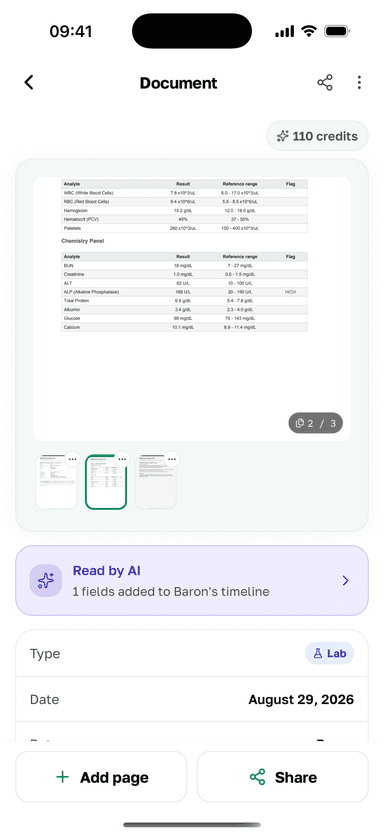
- A header: the patient, the owner, the requesting practice, the date and time the sample was
- One or more panels, grouped by what was run. A complete blood count and a biochemistry profile
- Within each panel, one row per analyte: a name or abbreviation, the measured result, the
- A flag column, usually H, L, or an arrow, marking results outside that interval.
- Sometimes comments from a clinical pathologist, which are part of the report and worth reading
The grouping is not decorative. A complete blood count is about the cells in blood — red cells, white cells, platelets. A biochemistry profile measures substances dissolved in it. They answer different questions and are read differently.
What a reference interval actually is
This is the part most worth understanding, because it is the part most often misread.
A reference interval is a statistical range derived from a population of animals considered healthy at the lab that produced it. It is not a target, not a goal and not a boundary between health and illness. It is a description of where most results from that reference population fell.
Three consequences follow and they are all practical:
Intervals are lab-specific. Different analyzers, methods and reference populations produce different intervals for the same analyte. Two reports from two labs are not directly comparable and neither are their ranges.
Units differ by region and by lab. The same substance can be reported in different units with numerically different values. Copying a number from one report into a range from another is a way of frightening yourself for no reason.
Being just outside is common. By the way reference intervals are constructed, a proportion of perfectly healthy animals will fall outside them on any given test. The more analytes are run, the more likely at least one falls outside by chance.
None of which means a flag can be ignored. It means a flag is a prompt for a conversation, not a finding on its own.
H and L are flags, not conclusions
A flag says a number sits outside a statistical range. It does not say why, whether it matters, or whether it is new.
What turns a number into information is context that is not on the page: the animal's age, breed, history, medication, what the last result was, how the sample was taken and handled and — above all — how the dog actually is. A result inside the interval can matter in context. A result outside it can be unremarkable for that individual.
Only your vet can do that and they have all of it. You have two sheets of paper.
The questions worth taking back
Rather than a glossary, take five questions to the follow-up call. They work regardless of what is on the report:
1. Which values are you actually paying attention to here and why those? 2. Is this a change from last time, or the first time we have measured it? 3. Does anything here change what we are doing? 4. Should this be repeated and when? 5. Is there anything I should be watching for at home in the meantime?
Write the answers on the report itself. In six months, the answers will matter more than the numbers.
What the app does with a lab report
Two separate things and they are worth keeping distinct.
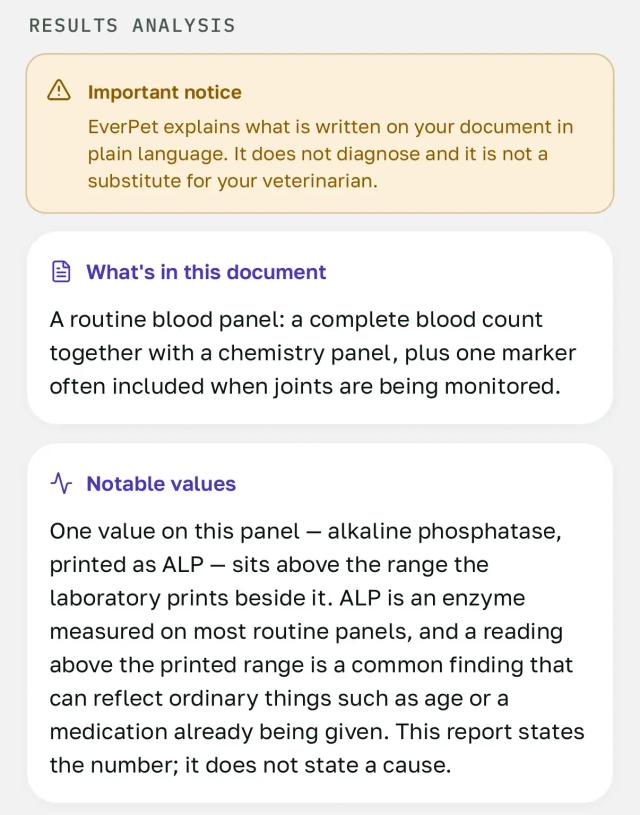
The first is extraction. A photographed report is parsed into structured fields and you review them — each suggestion individually accepted or skipped, one explicit commit, nothing saved until you take that action. Skipped suggestions stay recoverable. If a parse fails, the document is still stored and still perfectly usable; parsing failure never costs you the upload.
The second is AI Health Insights: a plain-language explanation of what a document contains, grounded in that document. It covers lab results and visit summaries only — two of the six document types the app handles. Prescriptions, vaccination records, insurance documents and everything else get no narrative explanation at all.
And the invariant underneath both: the AI never diagnoses and never gives medical advice. It describes what a document says. It does not tell you what a result means for your pet, does not suggest a course of action and does not replace the conversation above. Documents sent for parsing are not used to train the AI provider's models and the provider retains them only for a limited window. How the pipeline works end to end is on the AI page.
The useful thing to do tonight
Store the report where the next vet can see it, next to the last one. A single result is a data point. Two results six months apart, in the same place, in date order, are the thing that actually helps — and they help the person qualified to read them.
*This article is general information about how veterinary lab reports are structured. It is not veterinary advice and it is not a substitute for your veterinarian.*
Пов'язане
Встановіть EverPet
Безкоштовно для початку, на iOS та Android.